
<!-- article_id: junda-nitrile-south-america-sourcing-guide -->
Sourcing disposable gloves for South America is rarely a single-SKU exercise. A distributor in Colombia may need one glove for food handling lines, another for workshop use, and a third for janitorial crews — often in the same container. This guide is written for buyers comparing a nitrile gloves manufacturer for food processing automotive maintenance and cleaning in South America, and it focuses on the details that actually change your landed cost and your reorder rate: piece weight, texture, cuff length, packing configuration, carton cube and destination-market documentation.
Why one nitrile glove rarely covers all three end uses
Food processing, automotive maintenance and cleaning overlap in material but not in demand profile.
- Food processing typically prioritizes consistent fit, low particle shedding, and a colour policy that makes torn fragments easy to spot. Blue and white are common choices in this channel.
- Automotive maintenance usually pushes toward higher puncture and abrasion resistance, better grip on oily surfaces, and a heavier gauge. Diamond-texture orange references exist for this reason.
- Cleaning and janitorial sits between the two: buyers often want a lighter, lower-cost glove for high-consumption tasks, with enough chemical splash coverage for the chemicals actually in use.
Nitrile is a synthetic latex material, so it avoids natural rubber latex proteins — but that alone does not make a glove suitable for every chemical or every food contact task. Suitability depends on the specific chemical, contact duration, temperature and the glove's actual thickness and length. Buyers should test against their own task rather than rely on a general application list.
Matching glove construction to the task
Use the following as a decision framework, not a specification.
| Buyer priority | What to compare | Practical note |
|---|---|---|
| Food handling, inspection, light prep | Colour, fit consistency, cuff length | Colour policy is often set by the plant's foreign-body control program |
| Oily or wet parts handling | Surface texture, grip pattern | Diamond or raised textures generally improve wet/oily grip versus smooth |
| Longer cleaning shifts | Cuff length, piece weight | A longer cuff reduces splash ingress at the wrist |
| Heavy workshop tasks | Piece weight, puncture resistance | Heavier gauges cost more per piece but reduce change-out frequency |
Junda's approved product context covers disposable nitrile gloves in 9-inch as the main program, with 12-inch programs available, and colour options including blue, black, white and custom colour or weight programs. The 12-inch option is worth pricing if your cleaning or food accounts report wrist exposure — but confirm availability for your exact SKU before committing to a specification sheet.
Piece weight, net weight and carton gross weight are three different numbers
This is where most first quotations get misread.
- Piece weight is the weight of one glove, expressed in grams. It is model-dependent.
- Net weight is the total glove weight in a carton, excluding packaging.
- Carton gross weight includes gloves, inner boxes, the outer carton and any liner or label.
Approved reference values for two common configurations illustrate the difference. These are indicative and model-specific — they are not universal specifications:
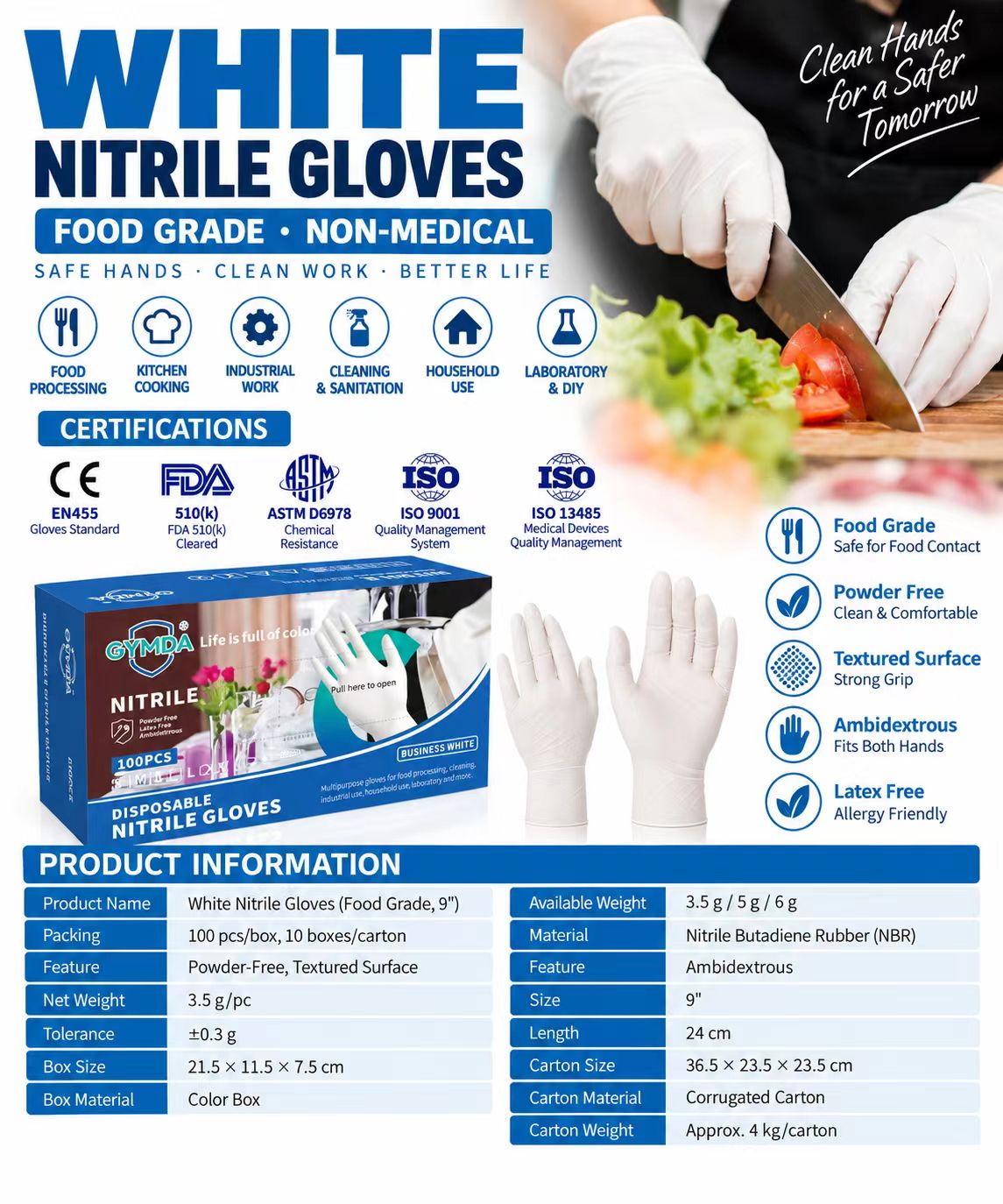
Standard 9-inch nitrile reference
- Piece weight options: 3.5 g, 5 g or 6 g (model-dependent)
- Packing: 100 pcs/box, 10 boxes/carton
- Box: 21.5 × 11.5 × 7.5 cm
- Carton: 36.5 × 23.5 × 23.5 cm
- Indicative carton weight: about 4 kg
Heavy-duty orange diamond-texture nitrile reference
- Packing: 50 pcs/box, 10 boxes/carton
- Box: 24 × 12.5 × 7.5 cm
- Carton: 39 × 26.5 × 25.5 cm
- Indicative carton weight: about 4.5 kg
Notice that the heavy-duty carton holds half as many pieces but weighs slightly more. If you are comparing quotations on a per-carton basis without normalising to per-piece weight and per-container cube, you are not comparing the same thing.
Container loading: why you should ask for a loading plan, not a guess
Carton dimensions drive how many cartons fit in a 20ft or 40ft container, and therefore your freight cost per glove. Small changes in carton size or box count per carton can shift the total loaded quantity meaningfully.
Because carton measurements and loading figures must be confirmed against the current packing list for your exact SKU, ask your supplier for a written loading plan that states:
- The exact SKU and piece weight
- Boxes per carton and pieces per box
- Confirmed carton dimensions and gross weight
- Cartons per pallet, if palletised
- Total cartons and total pieces per container type
- Whether the container is floor-loaded or palletised
Do not accept a loading figure carried over from a different model. Confirm it in writing before you book freight.
What actually drives your unit price
There is no single lowest unit price for nitrile gloves, and any supplier quoting one without your full order profile is guessing. Unit price depends on:
- Material and piece weight — heavier gloves use more compound
- Size mix — S/M/L/XL ratios affect production planning
- Box and carton configuration — 50 pcs/box versus 100 pcs/box changes packaging cost per piece
- Artwork and branding — printed boxes, custom colours and private label add setup and material cost
- Order quantity — larger runs amortise setup
- Destination and freight terms — port, Incoterm and mode all move the landed number
- Documentation requirements — destination-market documents may add handling steps
To get a usable quotation, send your supplier: the exact SKU or reference, piece weight, size breakdown, pieces per box, boxes per carton, colour, branding requirements, total quantity, destination port and required Incoterm. Request a quotation rather than a price list.
Documentation and verification before you commit
Two habits separate smooth importers from ones that get surprised at the port.
First, treat artwork as artwork. Logos or certification marks visible in a supplier's promotional images are not proof of current certification. Certification status must be verified through current, valid documents issued for the specific product and facility — not through a catalogue picture.
Second, confirm documents per destination market. South American markets differ in their import documentation requirements, labelling rules and conformity expectations. Requirements that apply in one country may not apply in another, and they change. Product and market documents must be confirmed for the exact order and the exact destination before quotation or shipment.
Build a pre-order checklist and get written confirmation on each line:
- Exact SKU, piece weight, length and colour
- Current packing list and confirmed carton measurements
- Gross weight per carton and per container
- Destination-market documents required for your product and country
- Labelling and language requirements for the retail or institutional box
- Artwork proof approval before production
Building a mixed container that works
If you are supplying multiple channels, a mixed container is often the most efficient route — but it needs planning. A practical approach:
- Split your volume by end use: food, workshop, cleaning.
- Assign a glove construction to each: standard 9-inch for food and light cleaning, heavier or textured for workshop, 12-inch where wrist coverage matters.
- Standardise what you can — a common box size across SKUs simplifies warehousing and reduces picking errors.
- Ask for a loading plan covering the full mixed order, not per-SKU estimates.
- Confirm documentation once, for the whole shipment.
You can review the base product range at Disposable Nitrile Gloves, and if your food or examination channel requires a different specification, compare it against Medical Nitrile Examination Gloves before deciding which line to quote.
Questions to send your supplier
Copy these into your next enquiry:
- For this SKU, what is the confirmed piece weight, length and cuff type?
- What is the current packing list — pieces per box, boxes per carton, carton dimensions and gross weight?
- How many cartons and pieces load into a 20ft and 40ft container for this exact SKU?
- Which colours and piece weights are available as standard, and which are custom programs?
- What documents can you provide for my destination market, and are they current?
- What is your quotation for [quantity], [size mix], [packing], delivered [Incoterm] to [destination]?
Clear answers to those six questions will tell you more about a supplier than any price list.
This article was prepared with automation assistance and reviewed against Junda's product and export-content rules.
---
JUNDA Gloves (Guangzhou, China, founded 1993) manufactures latex protective, disposable nitrile / latex / PVC and medical gloves, with certifications confirmed per model (EN 374, EN 455, FDA 510(k), ISO 9001 / 13485). OEM / ODM programs and samples available: www.jundagloves.com.