
<!-- article_id: junda-nitrile-eu-food-auto-cleaning-procurement -->
If you are sourcing a nitrile gloves manufacturer for food processing automotive maintenance and cleaning in Europe, the hardest part is rarely finding suppliers. It is comparing them on the same basis. Two offers can both say "9-inch, 5 g, 100 pcs/box" and still differ in piece weight tolerance, size mix, carton configuration, artwork and the documents your market expects. This guide walks through the variables that actually change your landed cost and your risk, and shows where to ask for written confirmation before you commit.
Start with the task, not the product name
Nitrile is a broad family, not a single specification. The same factory can run light 3.5 g examination-style gloves, standard 5 g and 6 g disposable gloves, and heavy-duty 7–8 g diamond-texture gloves. Those are different products for different jobs.
- Food processing and handling: buyers typically weigh grip, cuff length, and whether the glove stays intact through repeated handling. Colour can matter for detection and zone control.
- Automotive maintenance: heavier piece weights and textured surfaces are often chosen where oil, solvents and abrasion are present. A 12-inch program may be preferred for forearm coverage.
- Cleaning and janitorial: comfort over long shifts, cost per piece, and consistent sizing usually drive the decision.
None of these mappings are universal. A 5 g glove that suits light food handling may be the wrong choice for a workshop, and a heavy textured glove may be unnecessary cost in a low-risk cleaning task. Match material, texture, thickness and cuff to your actual task, then confirm the exact SKU with your supplier.
Piece weight, net weight and carton gross weight are three different numbers
This is where most quotation comparisons go wrong. Buyers often treat "5 g" as the whole story. It is not.
- Piece weight is the weight of one glove. It is model-dependent and can vary within a tolerance band.
- Net weight is the total glove weight in a carton, before packaging.
- Carton gross weight includes gloves, boxes, carton board and any inserts. This is the number freight forwarders and warehouse teams need.
Approved reference values, clearly labelled as model-specific and indicative only:
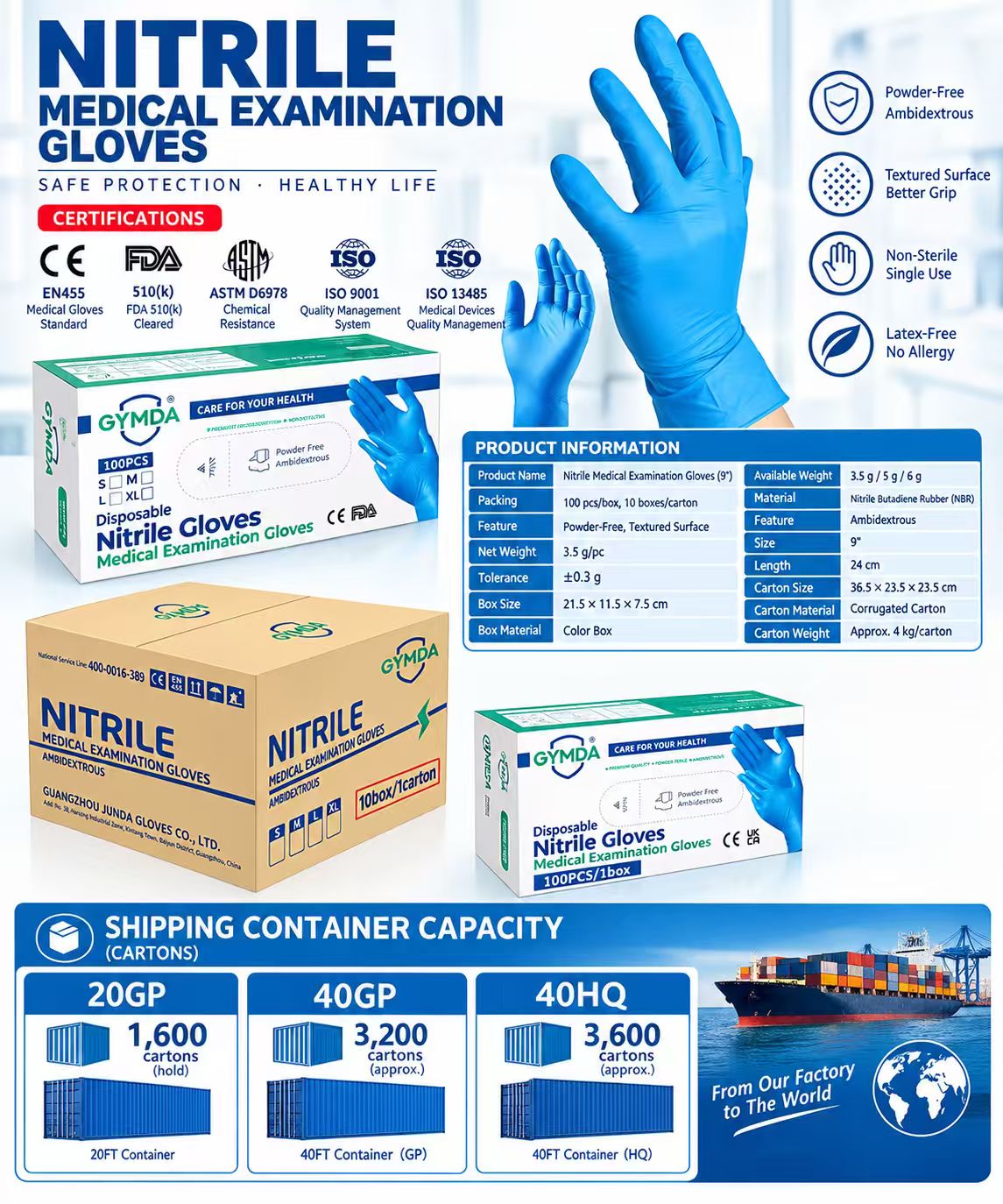
| Reference model | Piece weight | Packing | Box size | Carton size | Indicative carton gross weight |
|---|---|---|---|---|---|
| Standard 9-inch nitrile | 3.5 g / 5 g / 6 g options (model-dependent) | 100 pcs/box, 10 boxes/carton | 21.5 × 11.5 × 7.5 cm | 36.5 × 23.5 × 23.5 cm | about 4 kg |
| Heavy-duty orange diamond-texture nitrile | 7–8 g/pc | 50 pcs/box, 10 boxes/carton | 24 × 12.5 × 7.5 cm | 39 × 26.5 × 25.5 cm | about 4.5 kg |
Treat these as planning figures. Confirm the exact SKU, current packing list, carton measurements, gross weight, container loading and destination-market documents before quotation or shipment. Small changes in piece weight, size mix or box count per carton shift container utilisation and therefore your true cost per glove.
Why unit price cannot be quoted from a catalogue line
There is no single "nitrile glove price". Unit price depends on material, piece weight, size mix, box and carton configuration, artwork, order quantity, destination and freight terms. A buyer who asks only for "your best price on nitrile gloves" will get a number that is not comparable to anything.
To get a usable quotation, confirm:
- Exact SKU and model — including length (9-inch or 12-inch program), colour, and texture.
- Piece weight and tolerance — the specification you will inspect against.
- Size mix — S/M/L/XL ratios change the effective cost per usable glove.
- Packaging — pieces per box, boxes per carton, and whether project packs such as 100 pcs/box are required.
- Artwork and branding — custom colour or weight programs and printed boxes affect tooling and minimums.
- Order quantity — total pieces and cartons.
- Destination and Incoterm — port, delivery address, and who controls freight.
- Documents required — state clearly which market documents you need, and confirm them per order.
Ask for the quotation to state all of the above. A supplier who cannot break the price down by these variables is hard to hold to a specification later.
Documents, artwork and certification marks
Promotional artwork often shows certification logos. A logo in a catalogue image is not proof of a current certificate. Certification scope, issuing body, validity and the exact product covered all matter, and they can change.
Before you rely on any claim, request the actual documents and confirm they apply to the specific SKU and the destination market you are shipping to. Requirements differ across European countries and by application. Junda's position is simple: product and market documents must be confirmed for the exact order. Do not treat artwork as verification.
Choosing between standard and heavy-duty programs
A practical way to decide:
- If the task is light handling with frequent glove changes, a lighter piece weight usually lowers cost per piece without hurting performance.
- If the task involves oils, solvents, abrasion or longer wear cycles, a heavier textured glove may reduce glove changes and failures — but confirm it suits the chemicals and duration involved.
- If forearm coverage matters, ask about the 12-inch program rather than assuming a 9-inch glove will do.
- If colour is used for zone control or detection, confirm availability in blue, black, white or a custom colour program.
For the standard range, see Disposable Nitrile Gloves. If your application is closer to examination-style use, review Medical Nitrile Examination Gloves and confirm the correct SKU and documents for your market.
A short buyer checklist before you request a quote
- Define the task and the failure mode you are trying to avoid.
- Write a specification: length, piece weight, texture, colour, cuff.
- State packing: pcs/box, boxes/carton, project pack requirements.
- State total quantity and expected repeat order pattern.
- Name the destination port or address and the Incoterm.
- List the market documents you require.
- Ask for carton dimensions and gross weight for the exact SKU.
- Ask for the quotation to be valid for a defined period.
Send those eight items and you will get comparable quotes instead of catalogue guesses. Junda Gloves is a B2B glove manufacturer and exporter; we invite European buyers to request a quotation with the exact SKU, quantity, packaging, destination and Incoterm so pricing and documents can be confirmed against your order.
This article was prepared with automation assistance and reviewed against Junda's product and export-content rules.
---
JUNDA Gloves (Guangzhou, China, founded 1993) manufactures latex protective, disposable nitrile / latex / PVC and medical gloves, with certifications confirmed per model (EN 374, EN 455, FDA 510(k), ISO 9001 / 13485). OEM / ODM programs and samples available: www.jundagloves.com.