
<!-- junda-nitrile-gloves-canada-procurement-guide -->
Sourcing disposable gloves for Canada means balancing three different end uses — food handling, automotive maintenance and general cleaning — against one import program. A nitrile gloves manufacturer for food processing automotive maintenance and cleaning in Canada has to support that range without forcing you into three separate supply chains. This guide walks through the specification, packing and logistics decisions that actually affect your landed cost and your ability to reorder consistently.
Start With the Task, Not the Product Name
"Nitrile gloves" covers a wide band of products. Before you request pricing, define what each user group actually does:
- Food processing and handling: Users often need frequent glove changes, reliable fit and a color that makes contamination visible. Blue and black are common choices because they contrast with many food surfaces. Confirm whether your buyer or auditor expects a specific color or documentation set.
- Automotive maintenance: Tasks involve oils, solvents and longer wear cycles. A heavier piece weight and a textured grip surface usually matter more here than in food handling. Cuff length also affects how much forearm protection a technician gets.
- Cleaning and janitorial: Chemical contact time, grip on wet surfaces and cost per glove tend to drive the decision. Thinner gloves reduce cost but may tear faster under aggressive cleaning work.
Nitrile is a latex-free material, which is one reason it appears across all three categories. That said, material alone does not determine suitability — piece weight, texture, length and cuff style do. Compare those attributes against the real task rather than assuming one SKU fits every station.
Specification Choices That Change Your Unit Price
When buyers ask for a "lowest price," the honest answer is that unit price is a function of several variables. For disposable nitrile gloves, the main ones are:
- Material and piece weight. A 3.5 g glove and a 6 g glove are different products with different material consumption.
- Size mix. Glove sizes are not consumed evenly. A carton weighted toward small or extra-large can price differently from a balanced mix.
- Box and carton configuration. Pieces per box, boxes per carton and whether you need retail-ready or bulk packaging all affect cost.
- Artwork and branding. Custom printing, logo plates and private-label box design add setup and material cost.
- Order quantity. Larger runs spread fixed costs further.
- Destination and freight terms. Canadian destinations vary significantly in inland transport cost, and Incoterms shift who pays which leg.
Because of this, we do not publish a single numeric lowest unit price. Request a quotation with your exact SKU, quantity, packaging, destination and Incoterm, and the pricing can be built around your actual program.
Reference Specifications You Can Use for Planning
The values below are model-specific reference points, not universal specifications. Treat them as planning inputs and confirm the exact SKU, current packing list, carton measurements, gross weight, container loading and destination-market documents before quotation or shipment.
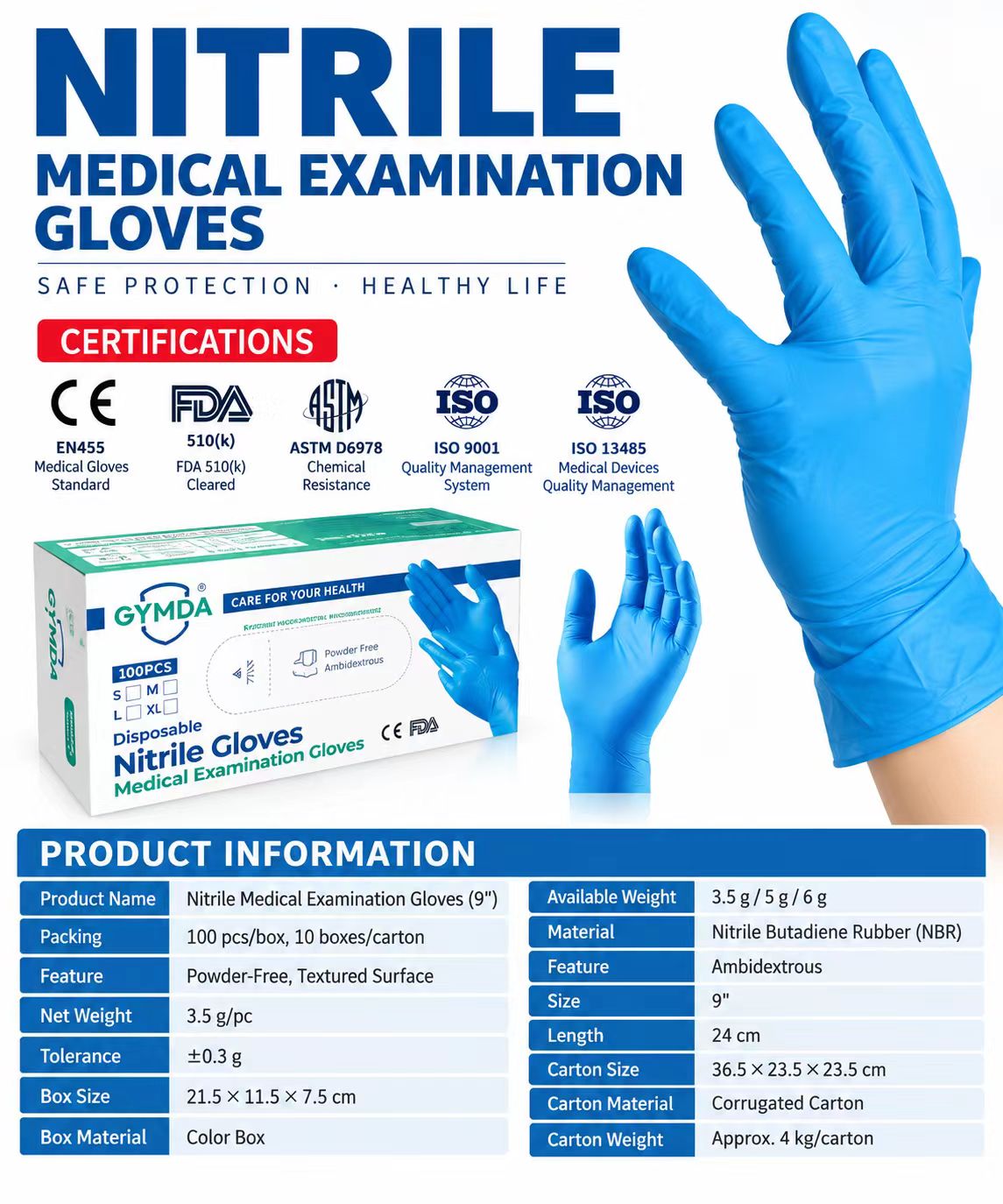
Standard 9-inch nitrile reference:
- Length: 24 cm
- Model-dependent piece weight options: 3.5 g, 5 g or 6 g
- Packing: 100 pcs/box, 10 boxes/carton
- Box: 21.5 × 11.5 × 7.5 cm
- Carton: 36.5 × 23.5 × 23.5 cm
- Indicative carton weight: about 4 kg
Heavy-duty orange diamond-texture nitrile reference:
- Piece weight: 7–8 g/pc
- Packing: 50 pcs/box, 10 boxes/carton
- Box: 24 × 12.5 × 7.5 cm
- Carton: 39 × 26.5 × 25.5 cm
- Indicative carton weight: about 4.5 kg
The product line is mainly 9-inch, with 12-inch programs available. Colors include blue, black, white and custom color or weight programs. See the disposable nitrile gloves range for the current product family, and the medical nitrile examination gloves page if your program requires a different specification track.
Piece Weight, Net Weight and Carton Gross Weight Are Not the Same Number
This is one of the most common sources of confusion in glove procurement, and it directly affects freight calculations.
- Piece weight is the weight of a single glove — for example, 5 g.
- Net weight is the total glove weight in a carton, excluding packaging.
- Carton gross weight includes the gloves, the inner boxes, the carton itself and any labels or inserts.
A carton listed at "about 4 kg" is a gross-weight figure. If you are building a container loading plan or comparing freight quotes, always ask which weight is being quoted. Two suppliers can cite the same piece weight and still ship cartons with different gross weights because of packaging differences.
Container Loading: Confirm, Don't Assume
Container loading depends on carton dimensions, palletization and whether your freight forwarder requires floor loading or pallets. The carton dimensions above are reference values for specific models. Before you commit to a volume order, confirm:
- Actual carton measurements for your chosen SKU
- Whether cartons ship loose or palletized
- Pallet height and weight limits for your destination
- Any Canadian importer requirements your customs broker has flagged
Small dimensional changes compound quickly across thousands of cartons, so get the current packing list in writing rather than working from an older quotation.
Documentation and Certification: Verify, Don't Infer
Promotional artwork often displays certification marks, logos or compliance icons. These are not proof of current certification. A logo printed on a box does not mean the factory holds an active certificate for the specific product you are buying.
Before you rely on any documentation claim:
- Ask for the actual certificate or test report, not a marketing image.
- Confirm the certificate covers the exact SKU and manufacturing site.
- Check the validity dates and the issuing body.
- Confirm which documents your destination market and your own customers require.
Exact documents must be confirmed by product and destination market. Requirements differ between food contact, medical and general industrial applications, and they can change. Your customs broker and your own compliance team are the right parties to confirm what applies to your shipment.
Building a Reorder-Friendly Program
For Canadian buyers running multiple sites, consistency matters as much as initial price. A few practices reduce reorder friction:
- Lock the SKU definition in writing. Piece weight, length, color, texture and cuff style should be documented, not implied.
- Keep packaging stable. If box counts or carton dimensions change between orders, your storage and freight planning breaks.
- Separate your programs. Food handling, automotive and cleaning may warrant different SKUs rather than one compromise glove.
- Plan size mix by site. Track which sizes run out first at each location and adjust the mix on the next order.
What to Send When Requesting a Quotation
To get an accurate quote rather than a placeholder, include:
- Exact SKU or specification (length, piece weight, color, texture, cuff)
- Target quantity, ideally with an annual forecast
- Size mix
- Packaging requirements (pieces per box, boxes per carton, private label or bulk)
- Artwork requirements, if any
- Destination city or province in Canada
- Incoterm
- Any documentation your market requires
With those details, a manufacturer can confirm the current packing list, carton measurements, gross weight and container loading for your specific order — and price against reality instead of assumptions.
This article was prepared with automation assistance and reviewed against Junda's product and export-content rules.
---
JUNDA Gloves (Guangzhou, China, founded 1993) manufactures latex protective, disposable nitrile / latex / PVC and medical gloves, with certifications confirmed per model (EN 374, EN 455, FDA 510(k), ISO 9001 / 13485). OEM / ODM programs and samples available: www.jundagloves.com.