
<!-- article_id: junda-latex-africa-procurement-guide -->
Sourcing a latex gloves manufacturer for medical examination dental laboratory and cleaning in Africa is rarely a single-SKU decision. The same buyer may need thin, tactile examination gloves for a clinic, slightly different handling characteristics for a dental laboratory, and a more durable household or long-cuff option for cleaning crews. Each of those tasks puts different demands on material, texture, thickness and cuff length, and each destination market applies its own import and documentation rules. This guide is written for procurement teams, distributors and institutional buyers who need to compare offers on equal terms rather than on headline claims.
Start with the task, not the product name
"Latex gloves" covers a wide family of disposable natural-latex products. Before requesting quotations, define what each user group actually does with the glove:
- Medical examination and clinical use: users typically prioritise tactile sensitivity, a secure fit and consistent barrier performance. Fit and surface finish matter more than maximum thickness.
- Dental laboratory work: tasks can involve small components, instruments and prolonged wear. Buyers should confirm with the manufacturer which surface (powdered or powder-free), texture and cuff option suits their specific workflow, because suitability depends on the task and cannot be assumed universally.
- Cleaning and household programs: longer wear times and contact with water, detergents and surfaces may point toward a heavier reference weight or a long-cuff design that protects more of the forearm.
Natural-latex disposable, examination, household and long-cuff programs are all available in the market, but options vary by exact model, size, surface and packaging. Write your requirement as a task description first, then map it to a model.
Compare offers on the same specification sheet
The most common procurement mistake is comparing a 6.5 g glove against an unspecified "exam glove" and treating the price difference as a supplier advantage. Ask every candidate manufacturer to quote against the same written specification. Useful fields include:
- Material and model name or SKU
- Length (for example, a standard 9-inch reference)
- Piece weight in grams
- Surface type and texture
- Cuff length and design
- Size range and size mix
- Packaging format (bulk box, unit-packed, pair-packed)
- Destination market and required documents
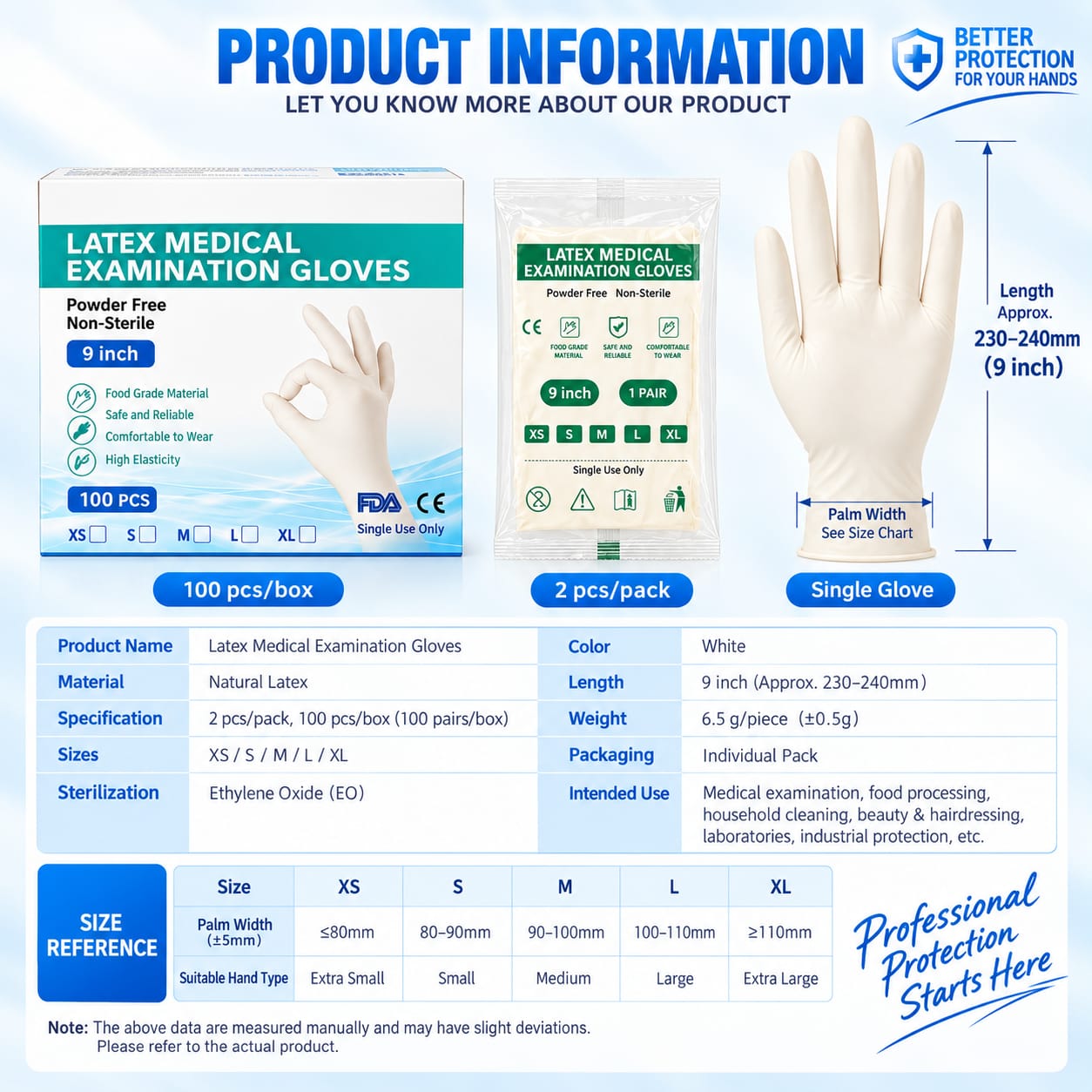
As a model-specific reference, a standard 9-inch latex examination / food-handling glove is described in Junda's reference sheet as natural latex, 24 cm in length with a 6.5 g/pc reference weight. This is a reference value for one model, not a universal specification — confirm the exact SKU and current specification before you build a purchase order around it.
Piece weight, net weight and carton gross weight are three different numbers
Buyers frequently confuse these, and the confusion shows up later in freight and customs calculations.
- Piece weight is the weight of one glove, expressed in grams. It is a specification of the product, not of the shipment.
- Net weight is the total weight of the gloves themselves in a carton, excluding packaging.
- Carton gross weight is the weight of the full sealed carton: gloves, inner boxes, polybags, carton board, labels and any inserts.
For one reference configuration, Junda's sheet lists 100 pcs/box and 10 boxes/carton, with a box size of 24 × 12.5 × 7.5 cm, a carton size of 39 × 26.5 × 25.5 cm and an indicative carton weight of about 6.5 kg. Treat these as indicative reference packing values for that model. Carton measurements, gross weight and container loading must be confirmed against the current packing list for the exact SKU you order, because a change in size mix, piece weight or packaging format changes all three.
Packaging choices that affect landed cost
Packaging is not cosmetic. It changes carton volume, which changes how many cartons fit in a container, which changes your landed cost per glove.
- Standard bulk boxes (for example, 100 pcs/box, 10 boxes/carton) are the usual starting point for distribution and institutional supply.
- Unit-packed two-piece or pair packaging can be discussed as a project option for clinical or dental settings where individual dispensing is preferred. Exact pieces per pack, pairs per box and any sterilization requirements must be confirmed with the manufacturer before quotation.
- Private-label artwork affects carton configuration and print setup, so include it in the brief from the start rather than after pricing.
If your tender requires a specific carton dimension or a maximum carton weight for manual handling, state it in the enquiry. It is far cheaper to design the packing around your constraint than to renegotiate after production.
Documentation must be confirmed by product and destination market
African markets do not share a single import regime. Requirements can differ by country and sometimes by port or by end-use category, and they can change. Before you commit to a supplier, confirm in writing:
- Which documents the manufacturer can provide for the exact SKU
- Which documents your destination market and your own customer require
- Whether any document needs to be issued or legalised in a particular format
Be careful with certification marks. Logos or certification marks visible in promotional artwork are not proof of current certification. A CE mark, an ISO reference or a food-contact symbol printed on a catalogue image tells you nothing about whether the certificate is current, whether it covers the specific model you are buying, or whether it is recognised in your market. Ask for the document itself, check the model and scope it covers, and verify validity through the issuing body where possible.
Why there is no single "lowest price" for latex gloves
Any quotation that gives you one number without asking about your specification is a number you cannot compare. Unit price depends on:
- Material and model
- Piece weight
- Size mix (a carton weighted toward small or extra-large sizes prices differently from a balanced mix)
- Box and carton configuration
- Artwork and private-label requirements
- Order quantity
- Destination and freight terms
Because of this, Junda does not publish a numeric lowest unit price. Instead, send your requirement and we will quote against it. To get a comparable quotation, confirm the exact SKU or specification, the quantity, the packaging format, the destination port or city, and the Incoterm you want to buy on. With those five items, two suppliers' quotes become genuinely comparable.
A practical enquiry checklist for African buyers
Before you send an RFQ to any latex gloves manufacturer, assemble the following. It shortens the quotation cycle and reduces the chance of a specification mismatch at shipment.
- End-use description for each glove type you need (clinical examination, dental laboratory, cleaning, food handling).
- Reference specification: length, piece weight, surface, cuff, size range.
- Size mix as percentages, not just "S to XL".
- Packaging format and any carton dimension or weight limits.
- Private-label artwork status and whether print plates exist.
- Order quantity per SKU and expected annual volume.
- Destination country, port or city, and preferred Incoterm.
- Document list required by your market and your customer.
- Any tender or shelf-life requirement.
Where to look at the product range
Two starting points on our site:
- Disposable latex gloves for examination, household and general disposable programs.
- Yuelong A3 latex protective gloves for a protective-glove option within the latex family.
Review the model pages, then send your specification and destination so we can confirm what applies to your exact requirement. Documentation, packing and loading will be confirmed by product and destination market before quotation or shipment.
This article was prepared with automation assistance and reviewed against Junda's product and export-content rules.
---
JUNDA Gloves (Guangzhou, China, founded 1993) manufactures latex protective, disposable nitrile / latex / PVC and medical gloves, with certifications confirmed per model (EN 374, EN 455, FDA 510(k), ISO 9001 / 13485). OEM / ODM programs and samples available: www.jundagloves.com.