
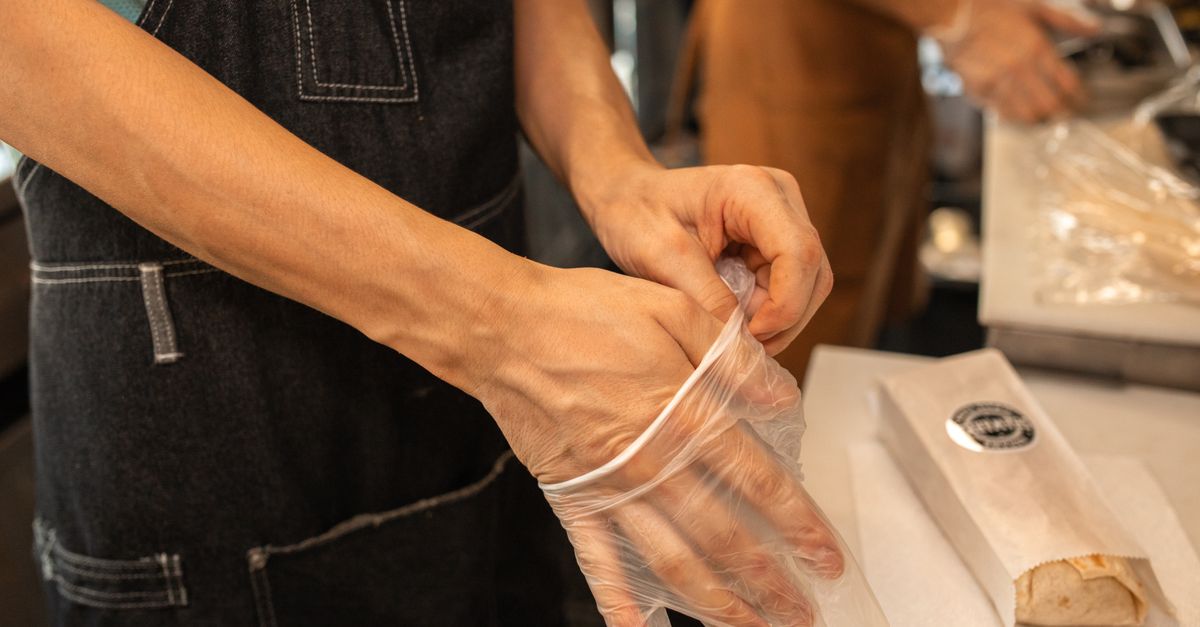
Working with a food handling gloves manufacturer for meat seafood bakery catering and kitchen work in Africa means matching the glove to the task, the climate and the shipping plan — not just picking a colour. Buyers across the continent often source for several end uses at once: a meat processor, a seafood packer, a bakery chain and a catering kitchen may all sit under one purchasing decision. This guide explains how to compare disposable nitrile, latex and PVC options, how to read packing and container figures, and which details to confirm before you request a quotation.
Start with the task, not the material name
Different food-handling tasks put different demands on a glove. Before comparing suppliers, list what each team actually does:
- Meat and poultry handling — frequent changes, wet and fatty surfaces, and a need for a secure grip. A textured surface and a consistent fit usually matter more than a very thin wall.
- Seafood and fish packing — wet, cold and slippery conditions; glove length and cuff behaviour affect how much water runs onto the forearm.
- Bakery and pastry work — dry handling, heat proximity and frequent glove changes; powder-free directions are often preferred where residue is a concern.
- Catering and kitchen service — high change frequency across a shift, so box configuration and dispensing matter as much as the glove itself.
- Cleaning and packaging — often a separate specification from direct food contact, and should be quoted as such.
Once the tasks are clear, material choice becomes a comparison rather than a guess.
Comparing nitrile, latex and PVC for African food operations
Disposable nitrile, latex and PVC options can be matched to food handling, packaging and cleaning applications. Each has trade-offs:
- Nitrile — a common direction for buyers who want a powder-free option and consistent black or white presentation. Reference food-handling directions include black or white nitrile with powder-free and textured-surface variants depending on the exact SKU.
- Latex — natural-latex options are widely used for food handling and examination-style work, with powder-free and textured directions available depending on the SKU. Buyers with latex-sensitive staff should discuss alternatives rather than assume.
- PVC — often considered for lighter-duty or cleaning-adjacent tasks; confirm the exact specification against the task rather than treating it as a substitute for nitrile or latex.
No single material is universally suitable. Compare material, texture, thickness and cuff against the actual task, and ask for the specification sheet for the exact SKU you are considering.
Reference specifications: what the numbers mean
The values below are user-supplied reference-sheet figures for orientation only. They are model-specific and not universal specifications. Confirm the exact SKU, current packing list, carton measurements, gross weight, container loading and destination-market documents before quotation or shipment.
Nitrile reference (9-inch, 24 cm length): model-dependent 3.5 g, 5 g or 6 g options. Reference packing for size M, approximately: 100 pcs/box, 10 boxes/carton (1,000 pcs). Nitrile 4.0 g carton approx. 36.5 × 23.5 × 23.5 cm, gross approx. 4.5 kg. Nitrile 3.5 g carton approx. 32.5 × 23 × 22 cm, gross approx. 4.0 kg. Cartons per container for nitrile: 20GP approx. 1,650–1,800; 40GP approx. 3,350–3,650; 40HQ approx. 3,800–4,150.
Latex reference (9-inch, 24 cm length): natural latex, reference weights 6.3 g/pc and 5.0 g/pc (size M). Reference packing: 100 pcs/box, 10 boxes/carton (1,000 pcs); box 24 × 12.5 × 7.5 cm. Latex 6.3 g carton approx. 39 × 26.5 × 25.5 cm, 0.0264 m³, gross approx. 6.8 kg; 20GP approx. 1,252, 40GP approx. 2,542, 40HQ approx. 2,883 cartons. Latex 5.0 g carton approx. 32.5 × 23 × 22 cm, 0.0164 m³, gross approx. 5.5 kg; 20GP approx. 2,006, 40GP approx. 4,074, 40HQ approx. 4,621 cartons.
Keep three weights separate in your own comparison sheet:
- Piece weight — the glove itself, e.g. 3.5 g or 6.3 g per piece.
- Net weight — the gloves in a carton, excluding packaging.
- Carton gross weight — gloves plus boxes, polybags and the carton, which is what freight and handling calculations use.
Mixing these up is one of the most common causes of a landed-cost surprise.
Packing, cartons and container planning for African routes
For importers shipping into African ports, container planning often decides whether a mixed order is practical. The reference figures above show why: a lighter glove can mean meaningfully more cartons per 40HQ than a heavier one, which changes freight cost per glove.
Practical steps:
- Decide the size mix first — size M dominates many food-service orders, but meat and catering teams may need a wider spread.
- Ask for the current packing list for each SKU, not a generic one.
- Confirm carton dimensions and gross weight before you calculate container loading.
- If you are combining nitrile and latex in one order, check whether the carton sizes allow efficient mixed loading.
- Confirm destination-market documents early — food-contact documentation must be confirmed for the exact product and destination market.
Quotation variables: why there is no single unit price
Unit price depends on material, piece weight, size mix, box and carton configuration, artwork, order quantity, destination and freight terms. That is why a responsible manufacturer will not quote a single number before these are known. When you request a quotation, include:
- Exact SKU or specification (material, weight, length, texture, colour, powder-free direction)
- Quantity and size mix
- Box and carton configuration, and whether you need private-label artwork
- Destination port and Incoterm
- Any documentation requirements for your market
For disposable gloves, MOQ is by full container — 40HQ / 40GP / 20GP. Latex protective gloves carry a separate MOQ of 10,000 pairs (JUNDA brand or OEM). Samples are free; the buyer's own international courier collects them from our Guangzhou factory and the buyer pays the courier directly, so contact us by email or WhatsApp before booking. Lead time is 15–30 days, with the exact date confirmed with the order. Payment arrangements follow the quotation and contract. Certificate previews are masked on the Quality page, and full documents are available on request.
Documentation and compliance: confirm, don't assume
Food-contact documentation must be confirmed for the exact product and destination market. This is not a formality — requirements differ between markets and between applications. Two practical cautions:
- Logos or certification marks visible in promotional artwork are not proof of current certification. Ask for the actual document for the SKU you are buying.
- A document that covers one product does not automatically cover a different weight, material or colour.
Build a simple checklist per SKU: product specification sheet, food-contact documentation for your market, current packing list, and carton measurements. Confirm each one in writing before the order is placed.
Building a repeatable supply plan
Buyers who order regularly across meat, seafood, bakery and catering tend to standardise on two or three SKUs rather than many. That simplifies documentation, makes container planning predictable and reduces the risk of a substitution at short notice. Review your specification annually against actual usage — if a team is double-gloving a thin glove, a heavier reference weight may be more economical overall even at a higher unit price.
For product details, see disposable nitrile gloves and disposable latex gloves. For MOQ, samples and ordering steps, see buying.
This article was prepared with automation assistance and reviewed against Junda's product and export-content rules.