
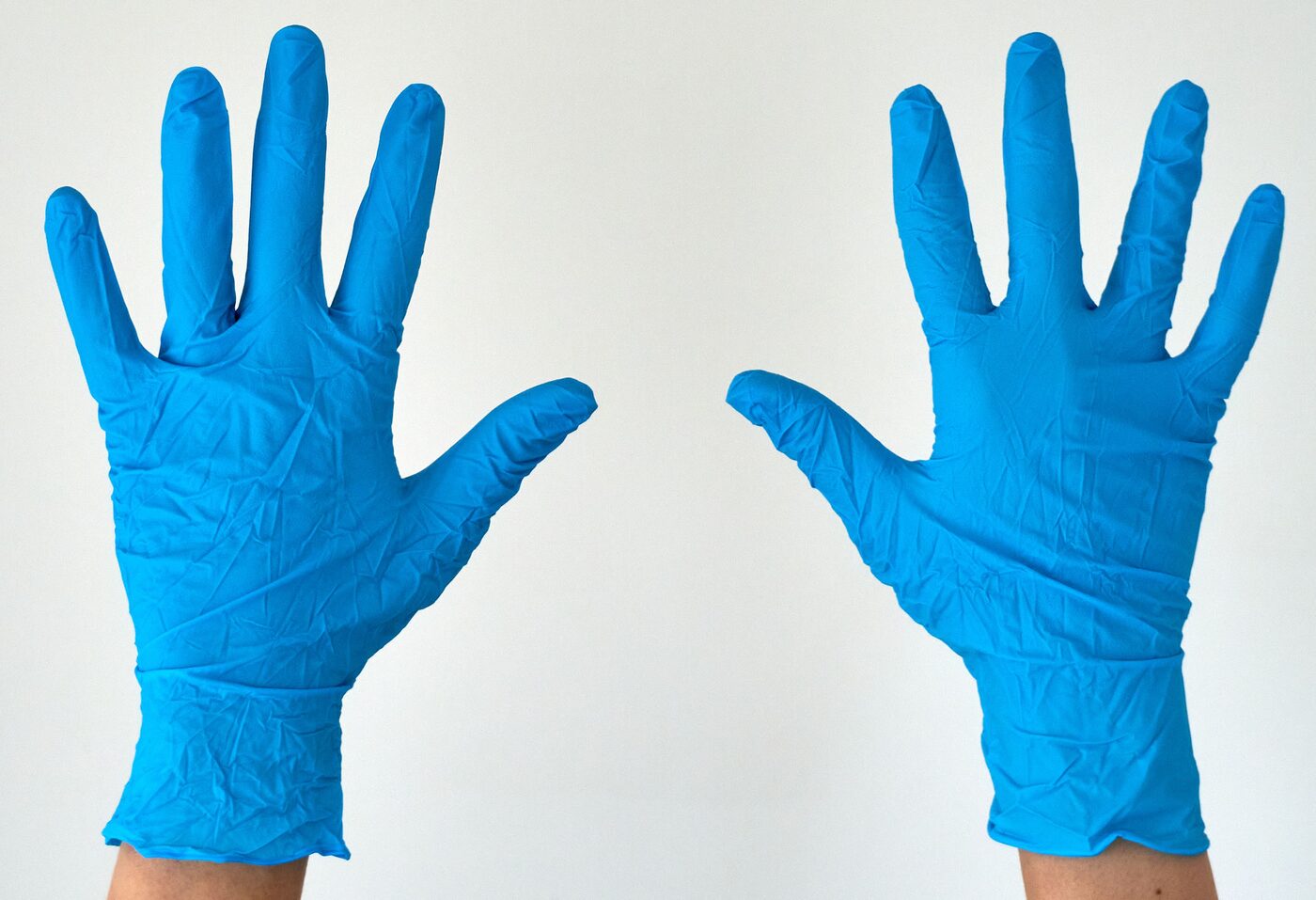
Buyers comparing disposable nitrile gloves often see the phrase accelerator-free next to more familiar words such as latex-free or powder-free. The three ideas are easy to mix together. They are not the same decision.
Nitrile is commonly chosen as a latex-free polymer when a workplace wants to avoid natural rubber latex proteins. That choice does not automatically mean the glove was made without rubber accelerators, or that residual process chemicals are absent. This guide helps B2B buyers separate Type I latex-protein allergy from Type IV delayed allergic contact dermatitis, and write RFQs that ask for evidence instead of brochure adjectives.
It does not claim that JUNDA manufactures accelerator-free nitrile gloves. Finish and formulation details must be confirmed against the live product discussion and current labeling. It is also not medical advice: occupational-health teams, clinicians, and patch-testing decisions stay with professionals. Buyers and end users should follow destination labeling and the files that belong to the exact SKU shipped.
Two different allergy conversations
Public health and regulator pages discuss more than one problem under the everyday word “allergy.” Procurement gets clearer answers when those problems are named separately.
| Issue | What it usually refers to | What a buyer can specify |
|---|---|---|
| Type I (immediate) natural rubber latex protein allergy | Sensitization to proteins in natural rubber latex (NRL), often discussed as an IgE-mediated reaction | A latex-free / not made with natural rubber latex polymer pathway—nitrile, vinyl (PVC), or another named synthetic. See latex-free gloves. |
| Type IV delayed allergic contact dermatitis | A delayed skin reaction linked to residual chemicals, including some accelerators used in rubber processing | A written process/composition declaration for that SKU, plus destination biological-evaluation and labeling files—not a slogan. |
| Irritant reactions (not the same as either allergy above) | Dryness or irritation from friction, occlusion, powder, frequent washing, or other workplace factors | Powder-free preference and glove-change discipline may be relevant; they do not prove either allergy pathway has been addressed. |
The U.S. FDA Medical Gloves page states that manufacturers must identify materials on labeling, and that people with a natural rubber latex allergy should choose gloves made from synthetic materials such as PVC, nitrile, or polyurethane. That guidance addresses Type I latex-protein risk. It does not tell you whether a nitrile glove is accelerator-free.
What “accelerator” means at buyer level
In rubber glove manufacturing, accelerators are process chemicals commonly discussed in connection with vulcanization / crosslinking—the step that helps the film develop its elastic, usable structure. Occupational-safety and dermatology literature often groups the chemicals buyers hear about into families such as:
- Thiurams
- Dithiocarbamates / carbamates
- Benzothiazoles / mercapto compounds
- In some papers, 1,3-diphenylguanidine (DPG)
An OSHA Safety and Health Information Bulletin on natural rubber latex gloves (SHIB 01-28-2008) notes that gloves—including NRL and some other materials—may contain chemical accelerators such as thiurams, carbamates, and benzothiazoles that can cause allergic contact dermatitis. The same bulletin notes that antioxidants, biocides, soaps, and other process chemicals may also contribute.
That list is a buyer-level vocabulary, not a JUNDA formula and not a complete inventory of every factory’s chemistry. Do not treat a blog article as a recipe, and do not assume every nitrile line uses the same accelerator family.
SATRA’s public summary of EN 455-3 adds a labeling and information duty that procurement can use: the manufacturer must provide details of harmful chemicals used, on request, and take precautions to reduce exposure. SATRA also notes Type IV residual-risk labeling for chemical ingredients such as accelerators, antioxidants, and biocides. For natural-latex products, SATRA restates that manufacturers must not claim “low protein content” or “low allergenicity.”
Nitrile is latex-free polymer—not automatically accelerator-free
This is the distinction most RFQs miss.
- Latex-free (more precisely, not made with natural rubber latex) is a polymer decision. Nitrile is a common synthetic choice. Vinyl/PVC is another. See latex-free gloves.
- Accelerator-free is a process / composition decision about whether certain vulcanization chemicals were used—and how residuals are controlled and declared—for the exact SKU.
- Powder-free is a finish / residual-powder decision. A powder-free nitrile glove can still be made with accelerators. See powder-free gloves.
A catalog line that says “latex-free nitrile” has not yet answered a Type IV chemical question. If your occupational-health policy or customer contract cares about accelerator families, write that requirement on its own line.
Vinyl / PVC is a different chemistry conversation
Vinyl (PVC) disposable gloves belong to a different polymer family and do not use the same rubber-vulcanization accelerator chemistry discussed above. Some buyers therefore look at vinyl when the question is residual rubber accelerators.
That comparison should stay careful:
- It does not make vinyl “hypoallergenic.”
- It does not mean vinyl is always safer, more durable, or suitable for every task.
- Other ingredients, plasticizers, fit, barrier performance, and destination labeling still have to be checked for the shipped SKU.
- If the glove will touch food, that is a separate discussion. See food-grade gloves.
Chemical-protection claims are also separate. Thin disposable gloves are not automatic chemical-resistant PPE. See chemical resistant gloves when solvents, oils, or prolonged contact are involved.
Why brochure words need matching evidence
Words such as “accelerator-free,” “hypoallergenic,” or “hospital grade” are easy to print. Buyers should ask what evidence sits behind them.
Peer-reviewed occupational dermatology literature discussing EN 455-3 notes that the absence of a substance may only be declared if it is not used in any part of manufacturing. The same literature reports that some gloves marketed as accelerator-free have still shown accelerators on analysis, and discusses cross-contamination at shared facilities as one possible explanation. Public reviews of rubber-accelerator allergic contact dermatitis also note that accelerator-free disposable nitrile options exist on the market generally. That is a market observation—not a statement that JUNDA offers them, and not a clinical guarantee about any unnamed product.
Buyer takeaway: ask for a process/composition declaration for the exact SKU. Do not treat the marketing phrase as a clinical guarantee, and do not assume a shared production site is irrelevant if “not used in any part of the process” is the claim you need.
A useful evidence package, where the destination market calls for it, can include:
- A written declaration of which accelerator families are used—or not used—in manufacturing of that SKU, in the EN 455-3 spirit of “not used in any part of the process” if absence is being claimed.
- Destination labeling, including any Type IV residual-risk language.
- Biological-evaluation or chemical-information files provided by product and market. JUNDA’s /quality page discusses masked previews and file types; a catalogue of file types is not per-SKU coverage.
- Current artwork that matches the lot you will actually receive.
This article does not claim to have tested any glove, and it does not diagnose dermatitis.
What to put in an RFQ
| RFQ line | Why it belongs there |
|---|---|
| Intended use | Examination, general-purpose, food-handling, or another named use changes claim boundaries. |
| Polymer | Nitrile vs vinyl vs latex is a material decision, not a slogan. |
| Latex-free pathway required? | Answers the Type I NRL-protein question; see latex-free gloves. |
| Accelerator-free / low-residual-chemical pathway required? | Answers a Type IV process-chemical question; ask only if it is a real requirement. |
| Written declaration for that SKU | Which accelerator families are used or not used in manufacturing; “not used in any part of the process” if absence is claimed. |
| Destination labeling and biological-evaluation files | Confirmed by product and market; start from /quality. |
| Powder-free if relevant | A separate finish question; see powder-free gloves. |
If chemical contact or mixed industrial use is also in scope, add that as its own line rather than burying it under an allergy heading. The distinctions in this article come from public laboratory and regulator summaries, not from any product test; confirm them against the current standard text and the shipped product’s files. This article does not tell workers which glove to wear, and it does not replace clinician or occupational-health judgment.
FAQs
Q1. If a glove is nitrile, is it automatically accelerator-free? No. Nitrile is a synthetic polymer commonly chosen for a latex-free pathway. Accelerator-free describes whether certain vulcanization chemicals were used (and how that is declared) for the exact SKU. Ask for the process/composition statement rather than inferring it from the polymer name.
Q2. Is Type I latex allergy the same as Type IV chemical allergy? No. Type I concerns proteins in natural rubber latex and is an immediate-allergy conversation. Type IV concerns delayed allergic contact dermatitis linked to residual chemicals such as some accelerators. FDA material-identification guidance for people with NRL allergy does not answer the accelerator-free question.
Q3. Can a supplier print “accelerator-free” without a process declaration? They can print many brochure words. Occupational dermatology literature discussing EN 455-3 says absence of a substance may only be declared if it is not used in any part of manufacturing. If that claim matters to your tender, ask for a written declaration tied to the shipped SKU, plus matching labeling.
Q4. Why might a glove marketed as accelerator-free still show accelerators in published analyses? Peer-reviewed reports have described that mismatch and discussed possible cross-contamination at shared facilities. The practical buying lesson is to ask how the exact SKU is made and declared—not to treat a catalog headline as a laboratory result. This article did not test any product.
Q5. Are vinyl gloves always a safer choice for Type IV risk? No. Vinyl does not use the same rubber-vulcanization accelerator chemistry, which is a real material difference, but that does not make vinyl “hypoallergenic” or automatically safer for every user or task. Fit, barrier needs, other ingredients, and destination labeling still have to be checked. Food-contact remains a separate discussion.
Q6. Does JUNDA manufacture accelerator-free nitrile gloves? Do not read that claim out of this article. Guangzhou Junda Gloves Co., Ltd. (JUNDA) manufactures disposable programs under brands such as GYMDA and supports OEM/private-label discussion. Production bases include Guangzhou and Shaoguan (GYMDA Shaoguan disposable base). Whether a given SKU is positioned as accelerator-free, which chemicals are used or not used, and how labeling reads must be confirmed against the live product discussion and current documents. Start from disposable nitrile gloves, /oem, /quality, and /buying.
Next steps for buyers
If accelerator residuals matter to your occupational-health policy or customer contract, write two separate lines: the latex-free polymer you need, and the process/composition declaration you need. Do not let “nitrile,” “hypoallergenic,” or “hospital grade” stand in for either line.
To discuss disposable glove categories for your market, contact JUNDA by Email at sales@jundagloves.com or via the site WhatsApp button. Share destination market, intended use, polymer preference, and documentation needs—including whether a latex-free pathway and/or an accelerator-related declaration is required—so the conversation stays tied to real labeling, not to a generic brochure phrase.