
<!-- article_id: junda-nitrile-gloves-us-procurement-guide -->
Sourcing a nitrile gloves manufacturer for food processing automotive maintenance and cleaning in United States operations is not a single-product decision. The same buyer category often spans three very different working environments: a food handling line where glove fragments and material contact matter, an automotive bay where solvent and oil resistance matter, and a janitorial or facility-cleaning crew where grip, cuff length and change-out frequency matter. A supplier who understands those differences can help you build one coherent glove program instead of three disconnected purchases.
This guide is written for US-based distributors, importers, and multi-site buyers who already know they want nitrile and now need to specify it correctly. It focuses on the procurement variables that actually change your landed cost and your end-user complaints: piece weight, texture, cuff length, packing configuration, carton and container math, and the documents that must be confirmed before you place a purchase order.
Start with the task, not the product name
"Disposable nitrile gloves" covers a wide band of products. Before requesting quotes, write down what each user group actually does:
- Food processing and handling: frequent change-outs, short wear cycles, and a preference for lighter, more flexible gloves that do not fatigue hands during repetitive tasks. Color choice sometimes matters for visibility and zone control.
- Automotive maintenance and repair: longer wear cycles, contact with oils, greases and shop chemicals, and a need for better grip when handling tools. Heavier gauges and textured surfaces are usually the relevant comparison.
- Cleaning and janitorial: a mix of water-based and solvent-based chemistry, plus a need for cuff coverage that reduces run-down. Grip on wet surfaces is often the deciding factor.
Nitrile is a synthetic latex material, which is why it is commonly chosen where latex protein concerns or chemical contact are part of the buyer's requirements. That said, no glove is universally suitable for every chemical or every task. Compare the material, texture, thickness and cuff choice against the buyer's actual task, and confirm suitability with the end user or a qualified safety professional.
Piece weight, net weight and carton gross weight are three different numbers
This is the single most common source of quotation confusion in glove sourcing. Buyers often compare "grams" across suppliers without confirming which gram figure is being quoted.
- Piece weight is the weight of one glove. It is model-dependent and directly affects feel, durability and material cost.
- Net weight is the total glove weight in a carton, excluding packaging.
- Carton gross weight includes gloves, boxes, carton board and any inserts, and it is the figure that matters for freight and manual handling.
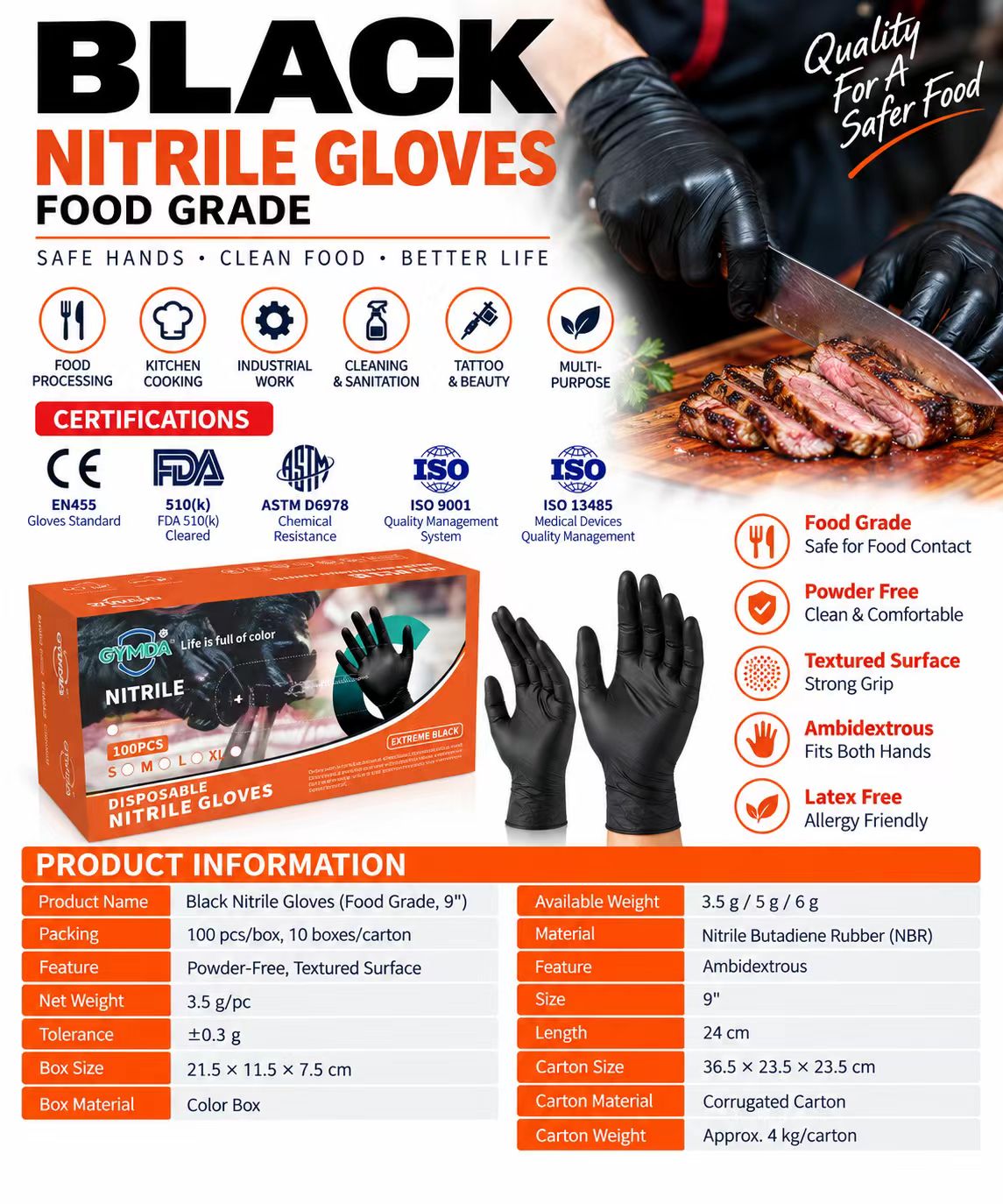
Approved reference values for Junda's disposable nitrile range include a standard 9-inch reference at 24 cm length with model-dependent 3.5 g, 5 g or 6 g options. A heavy-duty orange diamond-texture nitrile reference is listed at 7–8 g per piece. These are reference-sheet values for specific models, not universal specifications, and they must be confirmed against the exact SKU before quotation.
Packing, carton size and container loading: use indicative values, then verify
Packing configuration drives your warehouse labor, your retail or distributor presentation, and your container utilization. Approved indicative reference packing for the standard 9-inch nitrile range is:
- 100 pcs/box, 10 boxes/carton
- Box: 21.5 x 11.5 x 7.5 cm
- Carton: 36.5 x 23.5 x 23.5 cm
- Indicative carton weight: about 4 kg
For the heavy-duty orange diamond-texture nitrile reference:
- 7–8 g/pc
- 50 pcs/box, 10 boxes/carton
- Box: 24 x 12.5 x 7.5 cm
- Carton: 39 x 26.5 x 25.5 cm
- Indicative carton weight: about 4.5 kg
Treat all of these as model-specific and indicative. Carton measurements, gross weight and container loading must be confirmed against the current packing list for the exact SKU, because a size mix change, a box artwork change, or a switch between 9-inch and 12-inch programs can shift the numbers. If you are planning a mixed-SKU container, ask for a loading plan rather than estimating from a single carton.
Why there is no single "lowest unit price"
Buyers searching for a nitrile gloves manufacturer often want a headline number. A responsible manufacturer cannot give one without your specification, because unit price depends on:
- Material and piece weight
- Size mix (S–XL ratios change material consumption per carton)
- Box and carton configuration, including poly-bagging or retail-ready artwork
- Custom color, custom weight or private-label artwork
- Order quantity
- Destination and freight terms
- Incoterm (FOB, CIF, DDP and others allocate cost very differently)
For that reason, no numeric lowest unit price should be treated as valid unless it comes from a current approved quotation. The practical approach is to send the exact SKU, target quantity, packaging requirement, destination port or door, and your preferred Incoterm, then compare quotations on a like-for-like basis.
Documents to confirm before you commit
Product and market documents must be confirmed for the exact order and the destination market. Do not assume that a document set used for one SKU, one factory run or one destination applies to another. Before shipment, confirm:
- The exact SKU and current packing list
- Carton measurements, gross weight and container loading
- Destination-market documents required for your product category and channel
- Artwork approval, including label text and any marks you intend to print
One important caution: logos or certification marks visible in promotional artwork are not proof of current certification. Artwork is a design file, not a certificate. If certification status matters to your buyer or your market, request the underlying document and verify it independently.
Building a mixed program across three user groups
If you are supplying food processing, automotive maintenance and cleaning customers from one inventory, a workable structure is usually:
- A standard 9-inch nitrile in a light-to-mid piece weight for food handling and general cleaning, in a color that supports your zone or brand strategy.
- A heavier, textured option for automotive maintenance where grip and durability matter more than tactile sensitivity.
- A 12-inch program where cuff coverage is a stated requirement.
Junda's approved product context supports 9-inch as the main format with 12-inch programs available, project packs including 100 pcs/box, and blue, black, white and custom color or weight programs across food, cleaning, automotive and industrial applications. Review the disposable nitrile gloves range for the general-purpose program, and the medical nitrile examination gloves page if your buyers also purchase in that category. Confirm which SKU fits each user group before you finalize your line card.
A short pre-quotation checklist
Send your supplier these items in one message to avoid a slow back-and-forth:
- Exact SKU or the specification you want matched
- Piece weight target, if you have one
- Size mix and total quantity
- Box and carton configuration, plus artwork requirements
- Destination city/port and Incoterm
- Any destination-market document requirements
- Required delivery window
With those details, a manufacturer can quote accurately and you can compare offers on the same basis.
This article was prepared with automation assistance and reviewed against Junda's product and export-content rules.
---
JUNDA Gloves (Guangzhou, China, founded 1993) manufactures latex protective, disposable nitrile / latex / PVC and medical gloves, with certifications confirmed per model (EN 374, EN 455, FDA 510(k), ISO 9001 / 13485). OEM / ODM programs and samples available: www.jundagloves.com.