
<!-- article_id: junda-nitrile-africa-procurement-guide -->
If you are sourcing a nitrile gloves manufacturer for food processing, automotive maintenance and cleaning in Africa, the hardest part is rarely finding a supplier. It is comparing offers that look identical on the surface but differ in piece weight, packing configuration, carton cube and destination documentation. This guide is written for importers, distributors and industrial buyers who need to compare quotations on the same basis before placing an order.
Start with the task, not the product name
"Nitrile glove" covers a wide range. Before you request pricing, define what the glove has to survive in each of your end-use channels:
- Food processing and handling — frequent glove changes, contact with water, oils and food residues. Buyers often prioritise consistent fit, easy donning and a colour that makes detection of torn pieces practical.
- Automotive maintenance — exposure to oils, greases, fuels and solvents, plus abrasion from tools and sharp edges. Heavier gauges and textured grips are commonly requested here.
- Cleaning and janitorial — longer wear cycles, repeated wet contact and cleaning chemicals. Buyers frequently balance thickness against cost per shift.
A glove that suits one channel may be a poor fit for another. Rather than accepting a single "universal" recommendation, ask your supplier to map specific SKUs to each channel you sell into, and to state the piece weight and surface finish for each.
Material, length and cuff: the choices that actually change the quote
Disposable nitrile gloves are nitrile latex based. Within that, the commercial variables that move price and performance are:
- Length — 9-inch is the mainstream reference; 12-inch programs are available where forearm coverage is needed.
- Piece weight — commonly expressed in grams per piece. This is the single biggest driver of material cost.
- Colour — blue, black, white, and custom colour programs.
- Surface — smooth versus textured finishes; heavy-duty diamond-texture references exist for tougher tasks.
- Packing format — box count, carton count and carton dimensions.
Two quotations can both say "nitrile gloves, 100 pcs/box" and still differ substantially once piece weight and carton cube are compared. Always ask for both.
Reference specifications you can use as a comparison baseline
The values below are model-specific reference figures, not universal specifications. Treat them as a starting point for comparison, then confirm the exact SKU, current packing list, carton measurements, gross weight, container loading and destination-market documents before quotation or shipment.
Standard 9-inch nitrile reference
- Length: 24 cm
- Piece weight options: model-dependent 3.5 g, 5 g or 6 g
- Packing: 100 pcs/box, 10 boxes/carton
- Box: 21.5 × 11.5 × 7.5 cm
- Carton: 36.5 × 23.5 × 23.5 cm
- Indicative carton weight: about 4 kg
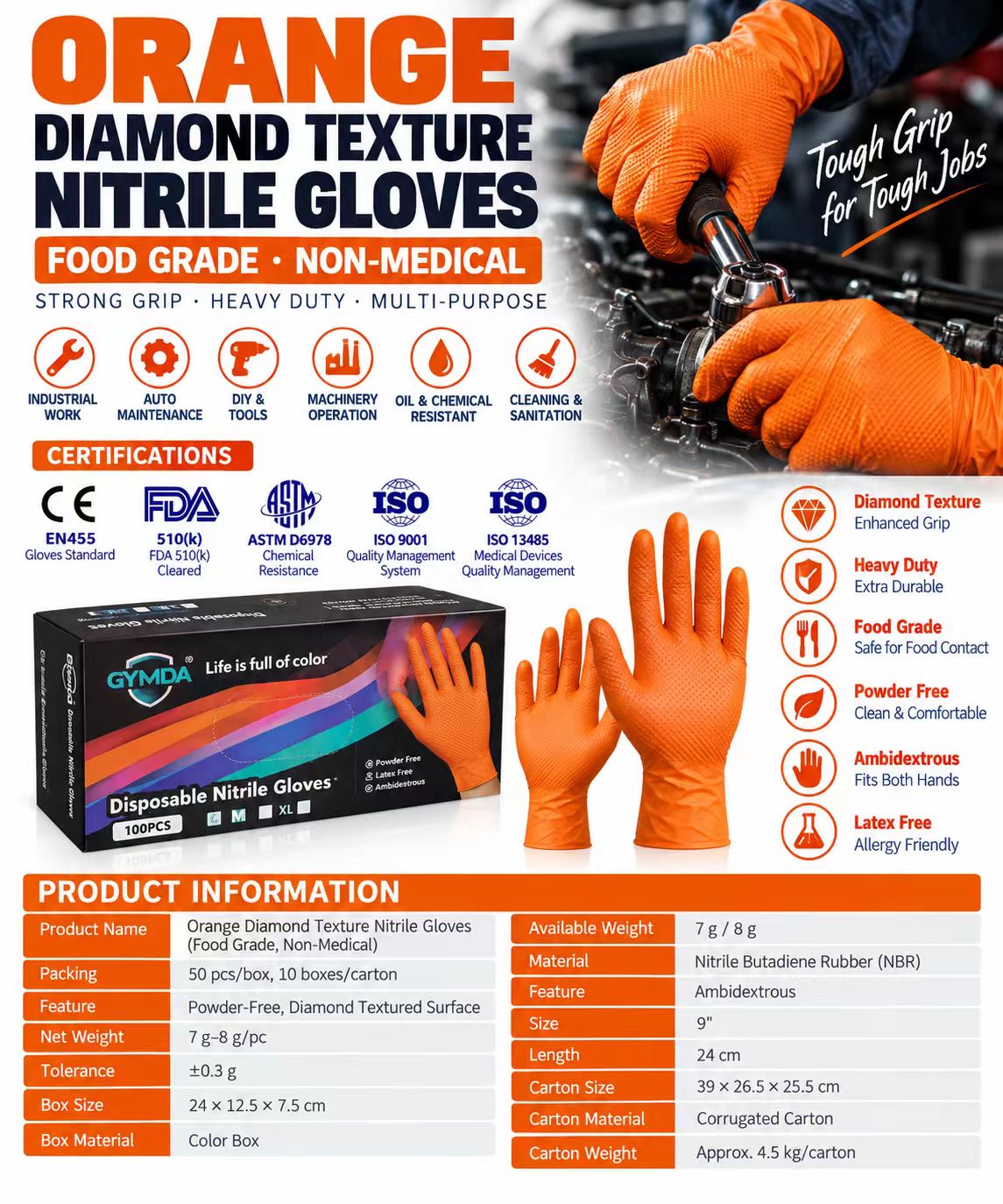
Heavy-duty orange diamond-texture nitrile reference
- Piece weight: 7–8 g/pc
- Packing: 50 pcs/box, 10 boxes/carton
- Box: 24 × 12.5 × 7.5 cm
- Carton: 39 × 26.5 × 25.5 cm
- Indicative carton weight: about 4.5 kg
Note the packing difference: the heavy-duty reference carries 500 pcs per carton versus 1,000 pcs for the standard reference. If you compare them on a per-carton price alone, you will misread the real cost per glove.
Piece weight, net weight and carton gross weight are three different numbers
This is where many African import quotations become confusing, so it is worth separating the terms:
- Piece weight — grams of glove material per single glove, e.g. 5 g.
- Net weight — total glove material in a carton. For a 1,000-piece carton of 5 g gloves, that is roughly 5 kg of gloves.
- Carton gross weight — net weight plus boxes, inner packaging and the outer carton itself. This is the figure freight forwarders and customs use.
The reference carton weights above (about 4 kg and about 4.5 kg) are indicative gross weights for those specific configurations. They are not a promise for your order. A different size mix, a heavier piece weight, extra inner packaging or custom artwork can all change the gross weight and the carton dimensions — which in turn changes how many cartons fit in a 20ft or 40ft container.
Why container loading must be confirmed, not assumed
Container loading is calculated from carton dimensions and gross weight, not from the product name. Because carton sizes vary between models and can change with packing configuration, ask for the current carton measurement and gross weight for the exact SKU you intend to buy, then have your forwarder calculate loading.
For African destinations, also confirm early:
- Which destination-market documents are required for your specific port and end use
- Whether your buyer requires any specific labelling or artwork on the box
- The Incoterm you are quoting on, since this changes what is included in the price
Product and market documents must be confirmed for the exact order. Logos or certification marks that appear in promotional artwork are not proof of current certification — always request the actual current documents for the SKU and destination you are buying.
What determines your unit price
There is no single lowest unit price that applies across orders. Unit price depends on:
- Material and piece weight
- Size mix (S/M/L/XL ratios)
- Box and carton configuration
- Artwork and printing requirements
- Order quantity
- Destination and freight terms
Because these variables interact, the practical approach is to send your supplier a complete brief and ask for a quotation against it. Include the exact SKU or reference, quantity, packaging preference, destination port and Incoterm.
A short procurement checklist for African buyers
Before you compare quotations, get these in writing from each supplier:
- Exact SKU reference and piece weight in grams
- Length (9-inch or 12-inch) and surface finish
- Box count, carton count, carton dimensions and carton gross weight
- Colour options and whether custom colour or weight programs are available
- Confirmation of which documents apply to your destination market
- Quotation stated against your quantity, destination and Incoterm
You can review the product range starting with disposable nitrile gloves, and if your food or examination channels require a specific specification, compare the medical nitrile examination gloves page as well. Confirm with the export team which SKU matches your application before ordering.
Request a quotation with the right information
To get a usable quotation quickly, send: product reference, piece weight preference, size mix, packaging format, quantity, destination port and Incoterm. With those details, Junda's export team can confirm the applicable SKU, current packing list and carton data for your order rather than quoting against generic assumptions.
This article was prepared with automation assistance and reviewed against Junda's product and export-content rules.
---
JUNDA Gloves (Guangzhou, China, founded 1993) manufactures latex protective, disposable nitrile / latex / PVC and medical gloves, with certifications confirmed per model (EN 374, EN 455, FDA 510(k), ISO 9001 / 13485). OEM / ODM programs and samples available: www.jundagloves.com.