
<!-- junda-latex-gloves-us-buyer-guide -->
Sourcing a latex gloves manufacturer for medical examination dental laboratory and cleaning in United States programs means matching one material family to several very different jobs. A dental laboratory handling impression materials, a clinic running routine examinations, and a cleaning operation working through cases of disposable gloves all touch natural-latex disposables, but they do not stress the glove in the same way. This guide is written for procurement teams, distributors, and private-label buyers in North America who need to compare offers on facts rather than on catalog photos.
Junda Gloves is a B2B glove manufacturer and exporter. The product context below is the only source for product-specific claims in this article, and every specification should be re-confirmed against the exact SKU and destination market before you place a purchase order.
Start with the task, not the product name
"Latex glove" covers a wide band of products. Before you request pricing, write down what the end user actually does:
- Medical examination and general patient contact: buyers typically look at fit, tactile sensitivity, and whether the glove is offered in a powdered or powder-free format. Exact claims depend on the model.
- Dental laboratory work: tasks range from chairside assistance to handling materials and instruments. Buyers should compare material, surface texture, thickness, and cuff length against the specific task rather than assuming one glove fits all laboratory steps.
- Cleaning and household use: longer, repeated wear and chemical contact may push buyers toward a different thickness or cuff option than a short examination glove.
Our approved product context covers natural-latex disposable, examination, household, and long-cuff programs, with options varying by exact model, size, surface, and packaging. That means the same manufacturer can quote several distinct constructions — and the buyer should confirm which one is being quoted.
Map the application to the right latex program
Use this as a discussion framework with your supplier, not as a universal specification:
| Buyer task | What to compare | Why it matters |
|---|---|---|
| Examination / patient contact | Model, size range, surface, packaging format | Fit and handling differ by SKU |
| Dental laboratory | Material, texture, thickness, cuff length | Task-specific demands vary widely |
| Cleaning / household | Cuff length, thickness option, packing | Longer wear and repeated use |
Two product pages are useful starting points for the conversation:
- Disposable latex gloves — the general disposable latex program.
- Yuelong A3 latex protective gloves — a protective-glove option to review against your task.
Neither page replaces a specification sheet. Ask for the current one.
Reference specifications: label them as model-specific
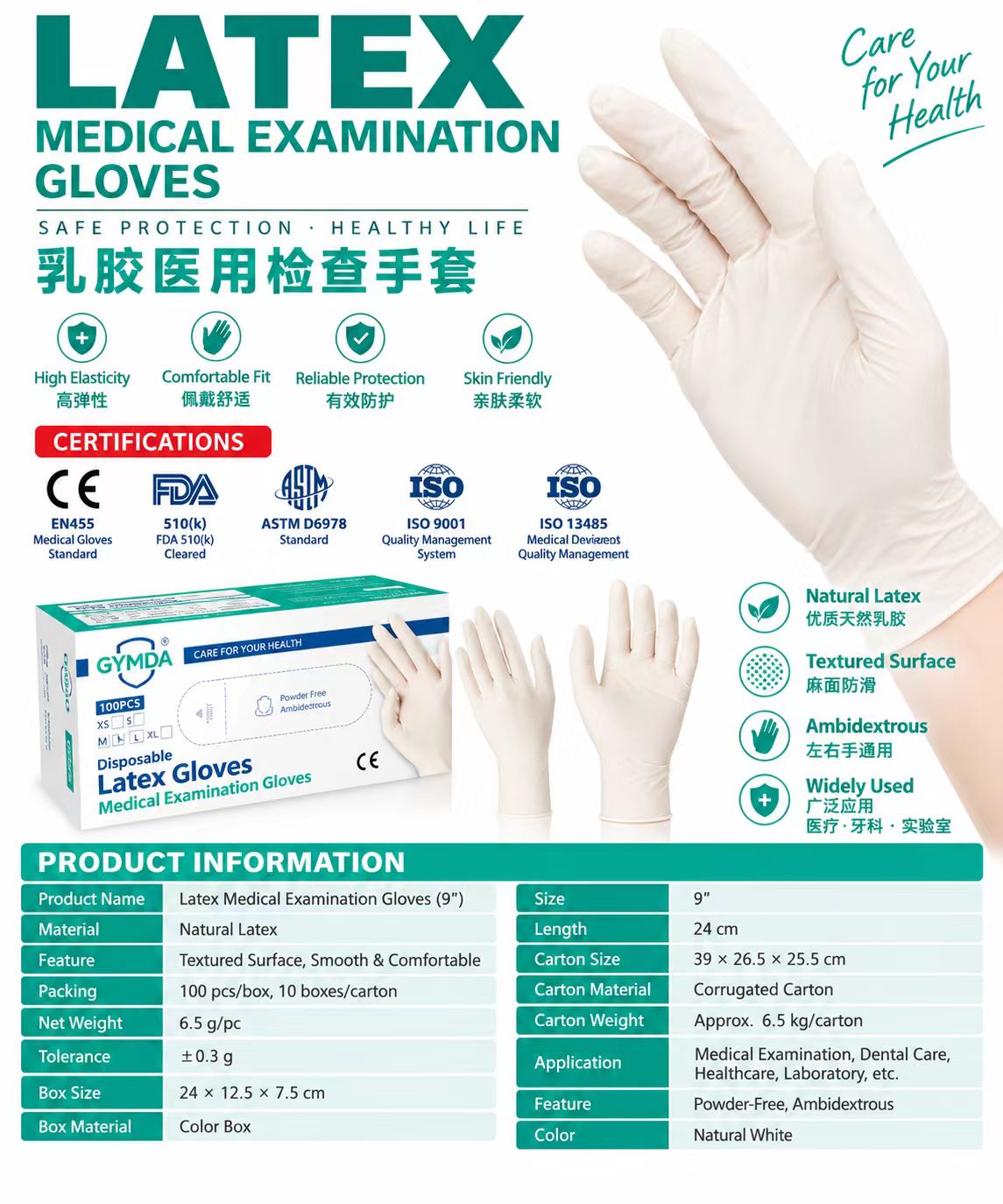
The following values are user-supplied reference-sheet values for a standard 9-inch latex examination / food-handling reference. They are indicative and model-specific, not universal specifications:
- Material: natural latex
- Reference length: 24 cm (9-inch class)
- Reference piece weight: 6.5 g/pc
- Reference packing: 100 pcs/box, 10 boxes/carton
- Reference box size: 24 × 12.5 × 7.5 cm
- Reference carton size: 39 × 26.5 × 25.5 cm
- Indicative carton weight: about 6.5 kg
Unit-packed two-piece / pair packaging can be discussed as a project option. Exact pieces, pairs, and any sterilization requirements must be confirmed before quotation.
Piece weight, net weight, and carton gross weight are three different numbers
Buyers often conflate these, and it causes disputes at the container-loading stage:
- Piece weight — the weight of a single glove (for example, the 6.5 g/pc reference above). It drives material cost per piece.
- Net weight — the total glove weight in a carton, excluding boxes, cartons, and inserts.
- Carton gross weight — the full shipped weight of the carton, including gloves, inner boxes, master carton, and any labels.
The "about 6.5 kg" figure above is an indicative carton weight for the reference packing. Your actual gross weight will move with piece weight, size mix, and packaging configuration. Always confirm the current packing list, carton measurements, gross weight, and container loading before you finalize freight.
What actually drives your unit price
There is no single lowest unit price for latex gloves. Unit price depends on:
- Material and piece weight
- Size mix (S/M/L/XL ratios change average piece weight)
- Box and carton configuration
- Artwork and private-label requirements
- Order quantity
- Destination and freight terms
Because these variables interact, the only accurate answer is a quotation against your exact requirement. When you request one, confirm the exact SKU, quantity, packaging, destination, and Incoterm so the quote is comparable across suppliers.
Documentation: confirm by product and destination market
Documentation requirements differ by product and by destination market. Do not assume that a document set used for one SKU or one market transfers to another. Before shipment, confirm:
- The exact SKU and current packing list
- Carton measurements, gross weight, and container loading
- Destination-market documents required for your specific product and market
A note on logos and certification marks: logos or certification marks visible in promotional artwork are not proof of current certification. Artwork is marketing material. If you need evidence of a certification, request the actual current document and verify it against the exact product and destination market.
A practical RFQ checklist for US buyers
Send this to any latex gloves manufacturer you are evaluating:
- Exact SKU and model name
- Application (examination, dental laboratory, cleaning, or other)
- Size range and expected size mix
- Surface and cuff preference
- Piece weight and reference length
- Packaging format (bulk, unit-packed, pair-packed)
- Box and carton configuration
- Order quantity and target shipment window
- Destination port or delivery point
- Incoterm
- Required destination-market documents
- Artwork and private-label requirements
A supplier who answers these in writing, with model-specific values clearly labeled, is easier to compare than one who replies with a single price and a photo.
Where Junda fits
Junda Gloves manufactures and exports natural-latex disposable, examination, household, and long-cuff programs, with options varying by exact model, size, surface, and packaging. We quote against your confirmed requirement rather than against a generic catalog line. Start with the disposable latex gloves range, or send your RFQ with the checklist above and we will confirm what applies to your SKU and destination.
This article was prepared with automation assistance and reviewed against Junda's product and export-content rules.
---
JUNDA Gloves (Guangzhou, China, founded 1993) manufactures latex protective, disposable nitrile / latex / PVC and medical gloves, with certifications confirmed per model (EN 374, EN 455, FDA 510(k), ISO 9001 / 13485). OEM / ODM programs and samples available: www.jundagloves.com.