
<!-- article_id: junda-latex-gloves-europe-procurement-guide -->
Choosing a latex gloves manufacturer for medical examination dental laboratory and cleaning in Europe is rarely a single-product decision. The same buyer often needs gloves for a GP clinic, a dental lab handling impression materials, and a contract cleaning team — three different tasks with three different risk profiles. This guide explains how to structure that comparison so you can shortlist suppliers on evidence rather than on catalogue photos.
Start with the task, not the product name
"Latex glove" covers a wide band of products. Before requesting samples, write down what each user group actually does:
- Medical examination — short-duration patient contact, frequent glove changes, need for tactile sensitivity and a consistent fit across sizes.
- Dental laboratory — longer wear periods, contact with impression materials, gypsum, waxes, monomers and abrasives; users often need better grip and may prefer a thicker or textured surface.
- Cleaning and household tasks — longer continuous wear, exposure to detergents and water, and often a preference for a longer cuff to reduce splash and run-down.
Natural-latex disposable programs, examination programs, household lines and long-cuff options exist, but the exact construction, surface finish, thickness and cuff length vary by model. There is no universal "latex glove" that is automatically correct for all three. Match the model to the task, then confirm the specification sheet for that exact SKU.
Material, texture, thickness and cuff: what to compare
When you evaluate a supplier, ask for the same four parameters across every candidate model so the comparison is fair:
- Material — confirm the base material stated on the technical file, not just the marketing name.
- Surface — powdered or powder-free, smooth or textured, and whether the texture is on the palm, fingertips or full glove.
- Thickness and piece weight — these are related but not identical. Piece weight is the mass of one glove; it is a useful proxy for material usage but should be read alongside the stated thickness and length.
- Cuff — standard length versus long-cuff, and whether a rolled bead is present.
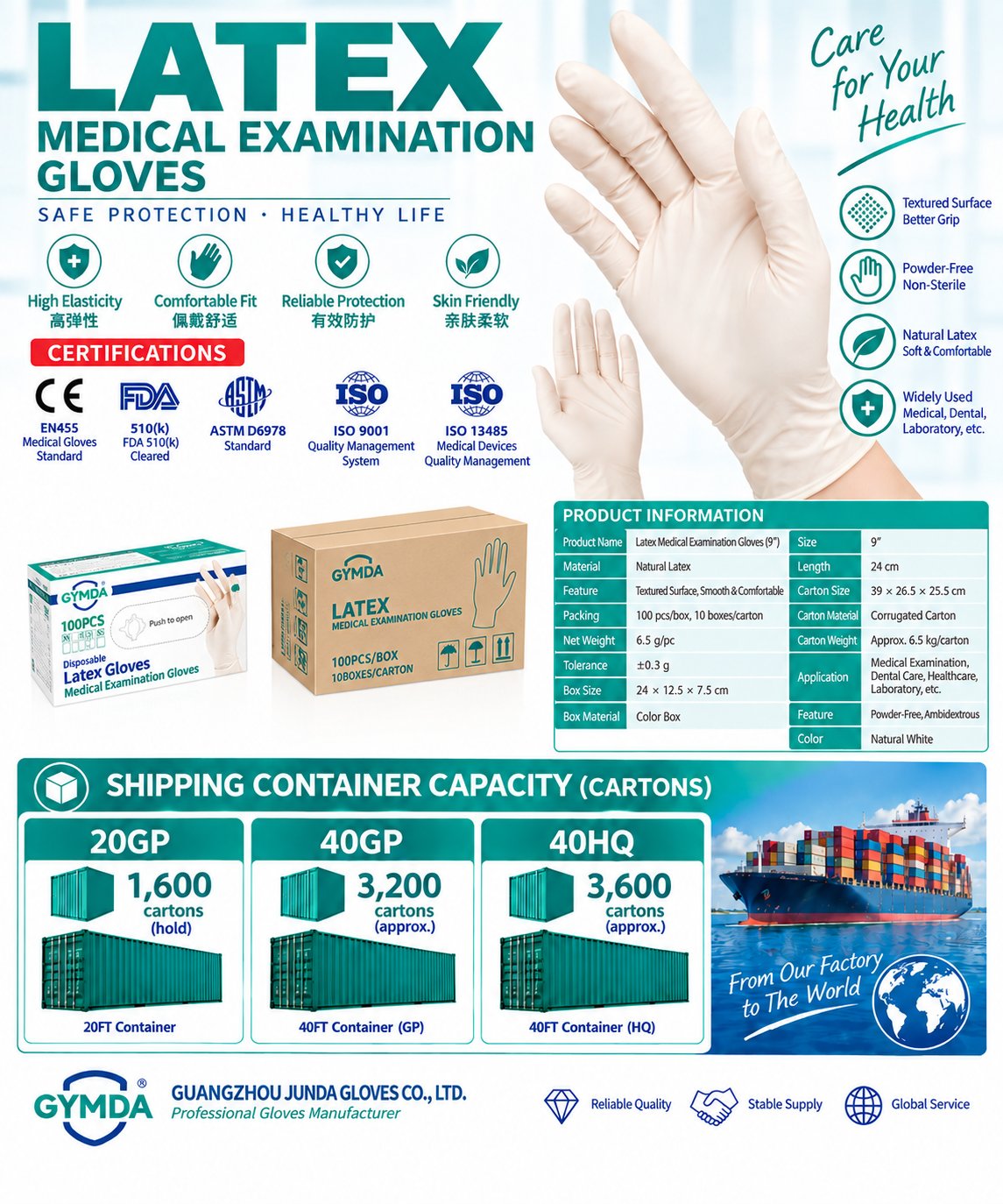
For reference, one commonly used standard 9-inch latex examination / food-handling reference is a natural-latex glove with a 24 cm length and a 6.5 g/pc reference weight. Treat this as a model-specific reference point, not a specification that applies to every latex glove. If your dental lab users report tearing during long procedures, a heavier or longer-cuff model may be more appropriate — but confirm the actual SKU data before switching.
Packing, carton size and weight: the numbers that drive your landed cost
Packing configuration affects freight, warehouse space and your own repack costs. Ask every supplier for the current packing list for the exact model you are quoting.
An indicative reference packing for a standard 9-inch latex examination glove is:
- 100 pcs per box
- 10 boxes per carton (1,000 pcs per carton)
- Box dimensions: 24 × 12.5 × 7.5 cm
- Carton dimensions: 39 × 26.5 × 25.5 cm
- Indicative carton weight: about 6.5 kg
These values are indicative and model-specific. They are not a guarantee for every latex glove, and they will change with size mix, piece weight, powder status and packaging format.
Three weights are often confused in quotations, so keep them separate:
- Piece weight — grams per single glove.
- Net weight — total glove mass in a carton, excluding packaging.
- Carton gross weight — gloves plus boxes, carton board and any inner packaging.
Container loading is calculated from carton dimensions and gross weight, so a small change in box height or piece weight can change how many cartons fit in a 20ft or 40ft container. Always ask for the current carton measurement and gross weight before you finalise a landed-cost model.
Unit-packed two-piece or pair packaging can be discussed as a project option for clinical or dental accounts, but the exact pieces per pack, pairs per pack and any sterilization requirements must be confirmed case by case.
Documentation: confirm by product and destination market
European buyers typically need a document pack that matches both the product and the destination country. Because requirements differ between EU member states and between medical, food-contact and general-purpose use, no supplier should promise a fixed document list in advance.
Ask for the documents that apply to your exact SKU and your destination market, and verify them directly. Important cautions:
- Logos or certification marks printed on artwork, boxes or catalogue pages are not proof of current certification. They are marketing elements. Ask for the underlying certificate or declaration and check its scope, validity date and the legal entity named on it.
- Documentation must be confirmed by product and destination market — a document set that works for one country or one glove model may not cover another.
- If your use case is a regulated medical application, confirm with your own regulatory or compliance advisor which classification and documents apply before you place an order.
Why there is no single "lowest price" for latex gloves
Buyers often ask for a lowest unit price up front. A responsible manufacturer cannot give a meaningful number without the full picture, because unit price depends on:
- material and piece weight
- size mix (S/M/L/XL ratios change material usage and packing)
- box and carton configuration
- artwork, printing and branding requirements
- order quantity
- destination country and port
- freight terms and Incoterm
For that reason, we do not publish a numeric lowest unit price. Instead, request a quotation with your exact requirements, and compare suppliers on the same basis: same SKU, same size mix, same packing, same destination, same Incoterm.
A practical RFQ checklist for European buyers
Send this to each candidate supplier so their quotes are comparable:
- Exact product and model reference (for example, a disposable latex examination glove or a long-cuff household model)
- Intended application: medical examination, dental laboratory, cleaning, or a mix
- Size mix and total quantity per size
- Powdered or powder-free, smooth or textured
- Cuff length and any thickness or piece-weight target
- Packaging format: bulk box, unit-packed, pairs, or retail-ready
- Artwork and branding requirements
- Destination country and port
- Incoterm
- Required documents for that product and market
You can review our disposable latex range at /products/disposable-latex-gloves and a protective latex option at /products/yuelong-a3-latex-protective-gloves as starting points, then confirm the exact SKU data with our export team.
What to verify before you commit
Before confirming any order, ask for and check:
- The current specification sheet for the exact SKU
- The current packing list, carton dimensions and gross weight
- The document set applicable to your product and destination market
- A pre-production or production sample from the actual line
These are user-supplied reference values and model-specific examples, not universal specifications. Confirm the exact SKU, current packing list, carton measurements, gross weight, container loading and destination-market documents before quotation or shipment.
To move forward, send us your application, size mix, packaging preference, destination and Incoterm, and we will prepare a quotation against your exact requirements.
This article was prepared with automation assistance and reviewed against Junda's product and export-content rules.
---
JUNDA Gloves (Guangzhou, China, founded 1993) manufactures latex protective, disposable nitrile / latex / PVC and medical gloves, with certifications confirmed per model (EN 374, EN 455, FDA 510(k), ISO 9001 / 13485). OEM / ODM programs and samples available: www.jundagloves.com.